Lean Six Sigma
Lean is often mentioned together with Six Sigma. This is not without reason, as these two improvement methods can be applied effectively in combination. While Lean focuses on speed and reducing waste, Six Sigma mainly focuses on making the quality of business processes measurable.
What is Lean Six Sigma?
Lean Six Sigma combines two proven improvement methods and aims to improve efficiency and quality within an organization. The Lean Six Sigma method brings together the key aspects of Lean and Six Sigma: on the one hand eliminating waste and delivering the highest possible value to the customer, and on the other hand continuously measuring and improving quality. With Lean, a smooth flow with maximum value creation is achieved, while Six Sigma simultaneously ensures consistent quality of the (leaned) business processes. In this way, Lean and Six Sigma strengthen each other.
How can organizations apply Lean Six Sigma?
Organizations can apply Lean Six Sigma to solve complex problems whose root causes are not immediately clear. The problem itself is known, but the underlying causes are still unknown. These causes are identified through data collection and statistical analysis of processes.
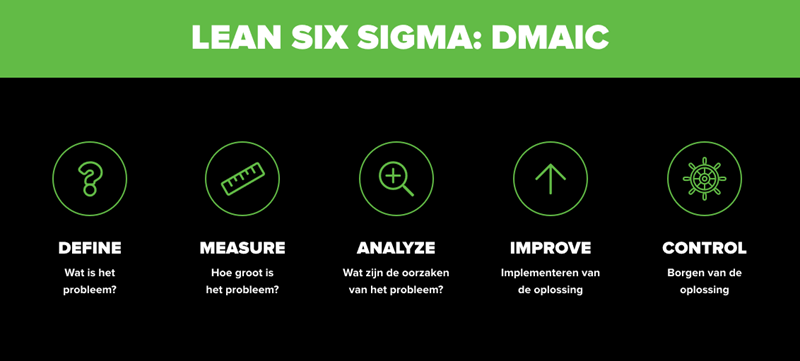
Six Sigma is a methodology that uses five steps: Define, Measure, Analyze, Improve, and Control (DMAIC). By following these phases step by step, processes are optimized in a structured way while ensuring consistent quality. The goal of this cycle is to determine which process variables (the x’s) have the greatest influence on the outcomes of a process (Y). By identifying these variables, organizations can understand what needs to be improved within a process.
What are the advantages of Six Sigma?
Applying the Six Sigma methodology offers several advantages:
Higher customer satisfaction
Increased profit
Higher productivity
Improved quality of products/services
Fewer errors within processes
Lean Six Sigma training
During a Lean Six Sigma training, you will learn how to identify waste of time and resources within a process and how to maximize the added value for the customer. You will also learn how the quality of a process can be measured using specific parameters. In addition, you will learn how to analyze measurement results and which methods can be used to improve and continuously control a process.
Explore our Green Belt training.
Who is the Six Sigma training suitable for?
A Six Sigma training is suitable for managers and executives in organizations who want to optimize processes and improve business performance. In addition, the training is suitable for employees who are involved in process control and process improvement within an organization.
Would you like to learn more about Lean Six Sigma?
We are happy to help you explore the possibilities for your organization. Contact us for more information.