Factory of the Future
How insight, collaboration, and continuous improvement transformed production, safety, and workplace satisfaction
The housing market in the Netherlands is under pressure. The demand for sustainable, affordable homes continues to grow, while capacity, personnel, and space are increasingly limited. Industrialized housing construction plays a key role in meeting this demand. BAM Wood Concepts develops and produces prefabricated wooden housing concepts, making a significant contribution to the Netherlands’ housing challenge.
To continue fulfilling this role in the future, BAM Wood Concepts needed to scale up. By 2026, the ambition was clear: produce more homes with the same workforce, without compromising on quality, safety, or workplace satisfaction. When our Master, David van Elk, started at BAM Wood Concepts on behalf of Masters In Lean, he immediately noticed something: “The machines were excellent, and there was a lot of technical knowledge, but the big picture was missing. Processes were not yet designed for flow and scalability.” Data usage was limited, improvements were not structural, and much energy was lost to daily disruptions.
Together with management, it was decided to take a different approach. Not by working harder, but by working smarter. A Lean scan marked the starting point, followed by a Green Belt program in which employees actively engaged in implementing improvements directly on the shop floor.
BAM Wood Concepts, the timber specialist within BAM, develops and produces innovative, sustainable, and industrially manufactured construction concepts. Building on this expertise, the company has now introduced FLOW: a circular wooden housing concept largely produced in modern factories. Thanks to this efficient building method, the structural shell of a home can be assembled on-site in just one day, reducing the total construction time from approximately 12 months to 3 months!
Challenge
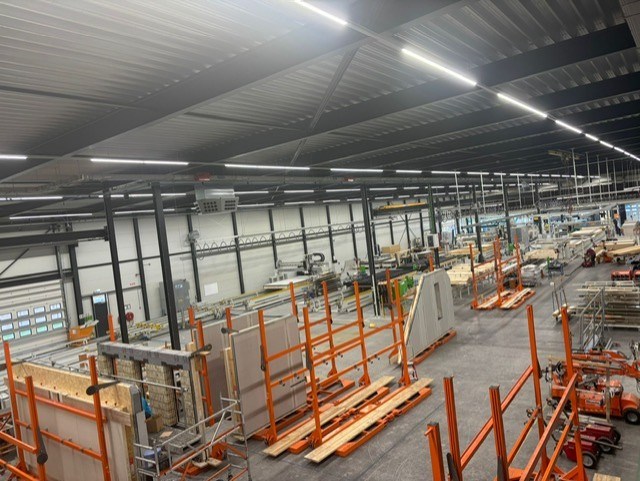
The biggest challenge lay within production itself. BAM Wood Concepts had invested heavily in machines and systems, but the overall workflow, how a product moves through the factory, was insufficiently structured. Handover points, waiting times, and errors in material supply caused downtime and frustration.
Work culture also played a role. Many employees worked the way they always had. Firefighting was central, while structural improvements hardly took place. Operational leadership, visual management, and standardized work were still limited.
Pressure was high: to double the production of the façade line by 2026 compared to the previous year, output had to increase significantly. Safety, quality, and employee satisfaction could not be compromised. “The urgency to improve was high,” says David. “That positive sense of urgency helped engage employees in a continuous improvement process."
Solution
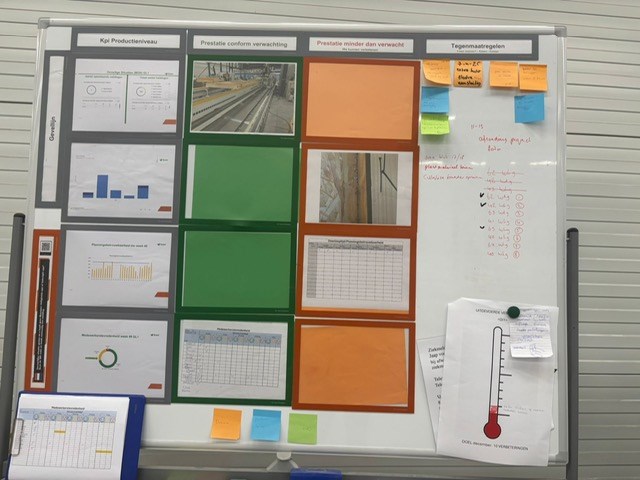
The program combined theory and practice. Employees were trained in Lean principles, guided through improvement projects, and actively involved in implementation on the shop floor. Tools such as value stream analyses, takt times, and Kanban systems made processes transparent and predictable. Cross-functional employee deployment and clear visual dashboards created flow, reduced downtime, and increased job satisfaction.
Our Master, Lies Weijtens, played a key role by providing 5S training, setting up KPI dashboards and visual management, and coaching employees in their daily work. She was frequently present on the shop floor as a dedicated point of contact and actively supported employees in executing their Yellow Belt projects.
“By actively involving employees and making them aware of waste, you can improve any production environment,” explains David. “This project shows that Lean is not an abstract concept, but a practical approach to achieving immediate results. This applies not only to BAM Wood Concepts but to any organization that wants to work more efficiently, increase safety, and engage employees in continuous improvement.”
Results
The trajectory delivered impressive results. The façade line increased output by 50% while staffing levels remained the same. The line’s rhythm became predictable, downtime was minimized, and work pressure was better distributed thanks to the cross-functional deployment of employees.
The work culture also visibly changed. Employees began actively reporting deviations instead of compensating for them, job satisfaction became measurable and openly discussed, and ownership over solving process issues increased. The MIP system and visual management made errors and improvements immediately transparent.
“By taking small steps each time, you naturally move closer to your goal,” says Max, foreman of the façade line and part of the Green Belt program. “By seeing opportunities instead of problems, we were able to make real progress in output and job satisfaction.”
Safety received extra attention. Risks were made visible, potentially unsafe situations were reported immediately, and they were included in daily reflections. This created a culture in which safety became a natural part of the work process and a measurable aspect of continuous improvement.
David also highlights the role of Donny van Dam, the interim production manager: “He brought his Lean expertise and worked closely with the team to embed improvements on the façade line and beyond. His impact was crucial to the program’s success.”
The effects went beyond the façade line: departments collaborate more effectively, digital reports reach the right person immediately, and fixed meeting structures were established. The improvements also had a direct impact on profitability: more output with the same resources, higher customer satisfaction, and safer working conditions.
The experience at BAM Wood Concepts shows that scaling up doesn’t start with new machines, it starts with insight, collaboration, and behavior. Organizations that want to grow in a tight market, whether in construction, industry, or logistics, benefit from predictable processes and teams willing to improve. As David summarizes:
“If you dare to make deviations visible and teach people to look at root causes instead of solutions, space is created for real improvement. That is the foundation for the factory of the future.”